TM Italia: Launching the First Connected Premium Kitchen
TM Italia designs and manufactures fully bespoke, luxury kitchens made entirely in Italy. For over sixty years, the company has combined traditional Italian craftsmanship with continuous research into materials, finishes, and integrated technologies.
TM Italia holds the ADI Compasso d'Oro (Italy's most prestigious design award) and was recognised as Italy's most circular SME by Confindustria. Its projects span private villas, penthouses, and architectural commissions across Europe, the Americas, and the Middle East.
A New Question for Kitchen Manufacturers
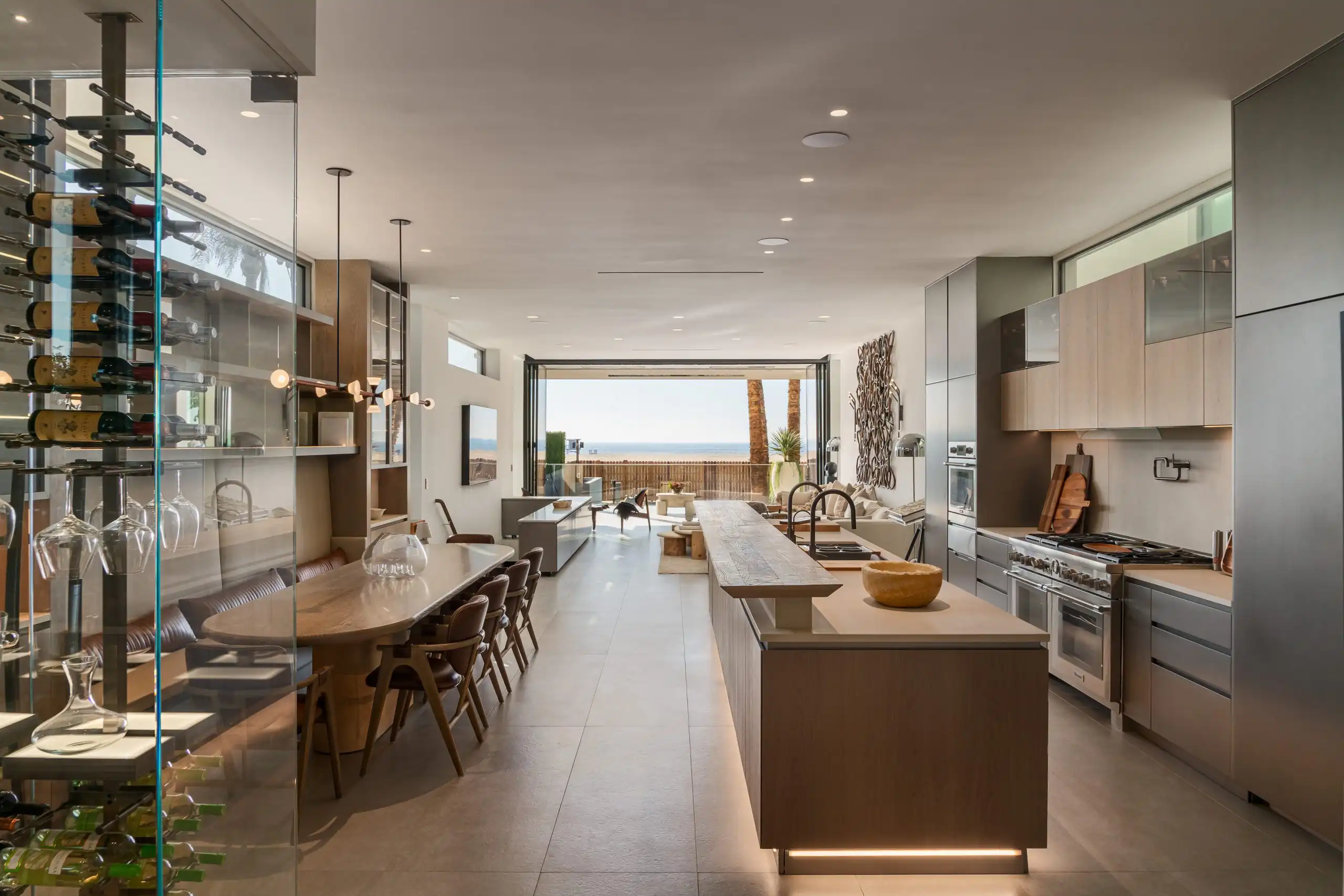
A project from TM Italia. Palisades, Santa Monica, USA.
For most kitchen manufacturers, the relationship with the customer ends the moment the kitchen is installed. The product leaves the factory, gets delivered, and disappears into a home. What happens next is largely invisible: how it is used, whether everything works as intended, what the customer actually needs.
TM Italia asked a different question: what if the kitchen could stay connected?
The answer was not about adding a few smart switches. The vision was complete: a branded app for the end customer with real-time device control and safety monitoring, comfort scenarios that adapt to how people cook and live, and a manufacturer backoffice that keeps the entire connected fleet within reach.
Building this required three distinct competencies: a hardware layer for sensing and actuation in the kitchen, an IoT cloud infrastructure to connect and manage devices at scale, and a mobile app that makes it genuinely enjoyable for end customers to interact with their kitchen.
A Three-Way Partnership
The smart kitchen ecosystem was built jointly by three actors, each contributing where they are strongest.
Airbag Studio designed and developed the entire end-customer mobile app, for iOS and Android, from scratch. Airbag Studio took full ownership of the user experience: onboarding flows, real-time dashboards, scenario management, push notifications, event history, device diagnostics, and voice assistant integration. The app is what the end customer sees, touches, and judges.
Connhex provided the IoT cloud infrastructure: device provisioning and lifecycle management, secure bidirectional communication between cloud and field (via an open-source add-on for Home Assistant), user and kitchen registry, data storage, and the APIs consumed by both the mobile app and the backoffice. Critically, it also brought a ready-made identity and access management system: end customers can only see and control their own kitchen, installers have a separate role scoped to their assigned jobs, and the TM Italia team has full fleet visibility through the backoffice. Airbag Studio did not have to design or build any of this permission logic.
TM Italia defined the product vision, kitchen hardware integration, brand guidelines, installation requirements, and go-to-market strategy. They are the manufacturer and, after this project, the operator of a connected fleet.
This model has a clear property: each partner focuses exclusively on what they do best. The cloud infrastructure does not need to be rebuilt for each new project. The app developer does not need to think about MQTT, certificates, or device provisioning. The manufacturer does not need to hire a cloud engineering team.
The Smart Kitchen App
The end-customer app was designed for people who are not interested in managing devices. They want to cook, feel safe, and come home to a kitchen that works.
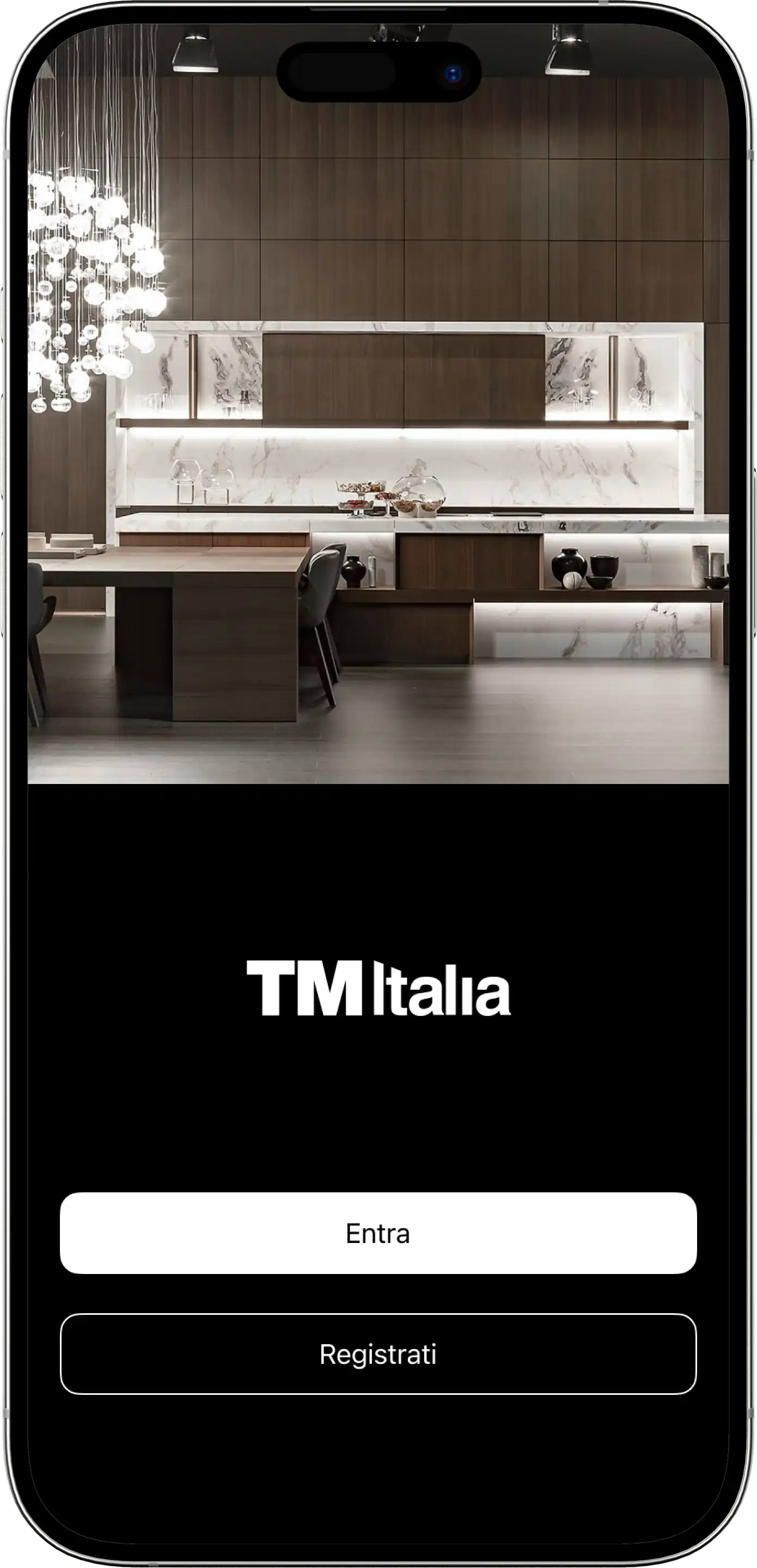
Onboarding happens by scanning a QR code that is associated with the kitchen during installation. In a few seconds, the customer's account is linked to their specific kitchen and all its connected components.
The real-time dashboard shows the status of every connected device at a glance: safety sensors, lighting, and motorized elements. Active alarms surface immediately.
Manual control gives full access to every connected actuator. Every switch, relay, and light can be operated individually from the app, without any technical knowledge required.
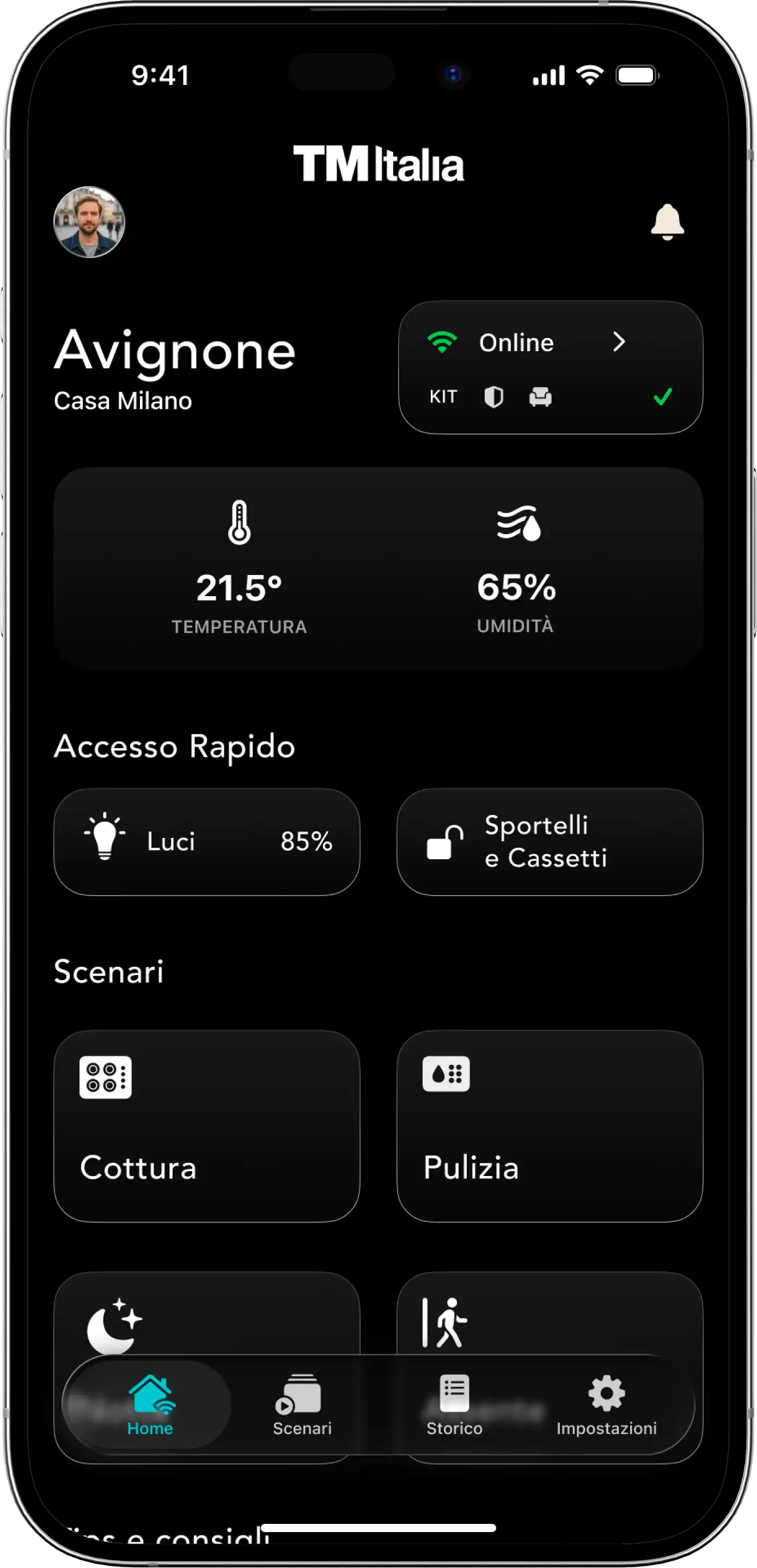
Scenarios are where the system becomes genuinely useful day-to-day. Complex combinations of sensor states and actuator positions can be configured as named automations ("cooking mode", "leaving home", "night mode") and activated with a single tap. Customers can use pre-configured scenarios or define their own.
The notification system operates on two levels. Critical alerts (smoke, gas, or water detection) are pushed immediately and persistently. Informational notifications cover lower-priority events such as a sensor going offline or a scenario executing automatically.
Event history provides a complete log of everything that has happened in the kitchen, filterable by device, event type, and time range. Device diagnostics give visibility into battery levels, signal strength, and connectivity status for each sensor and actuator.
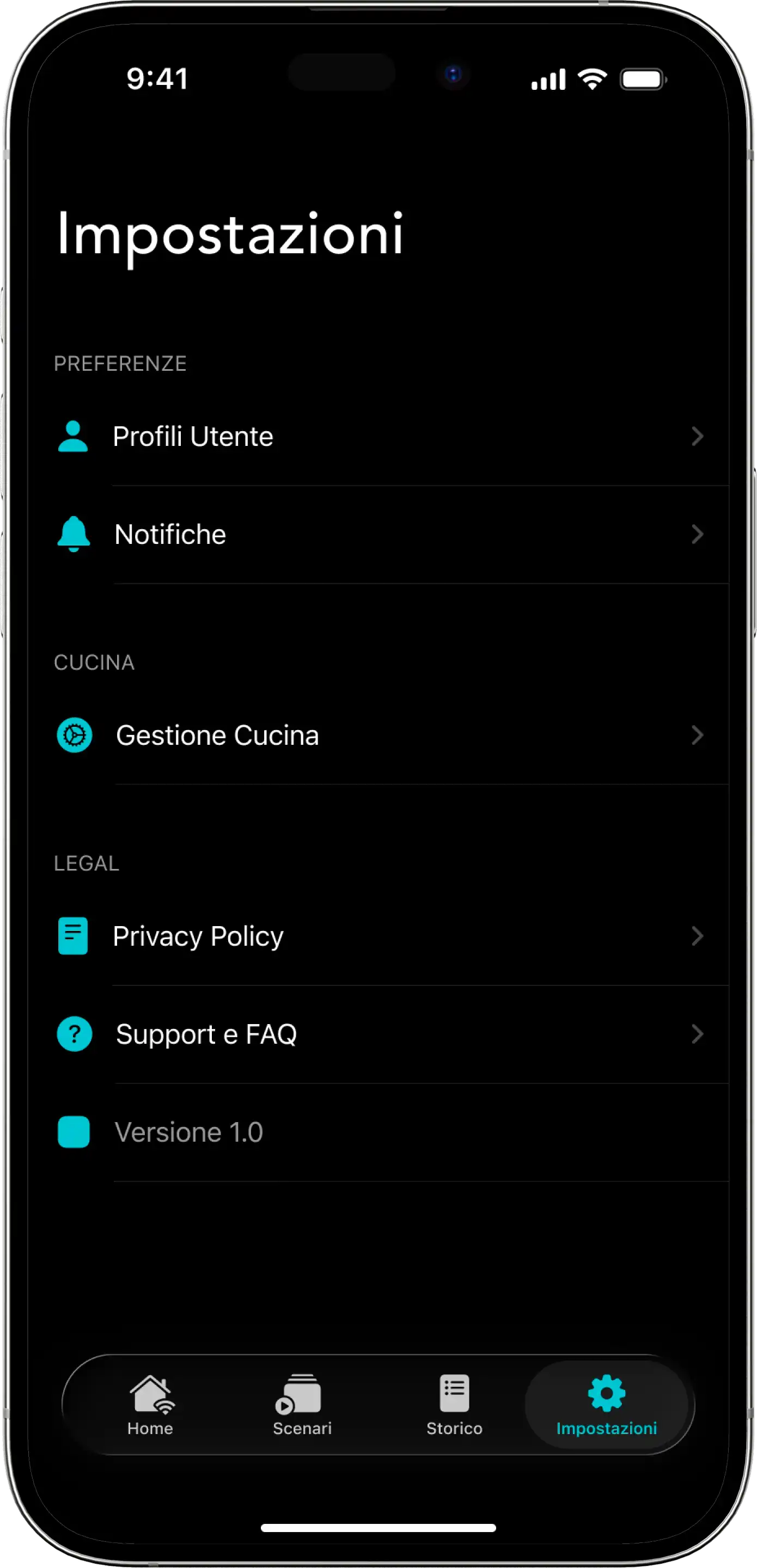
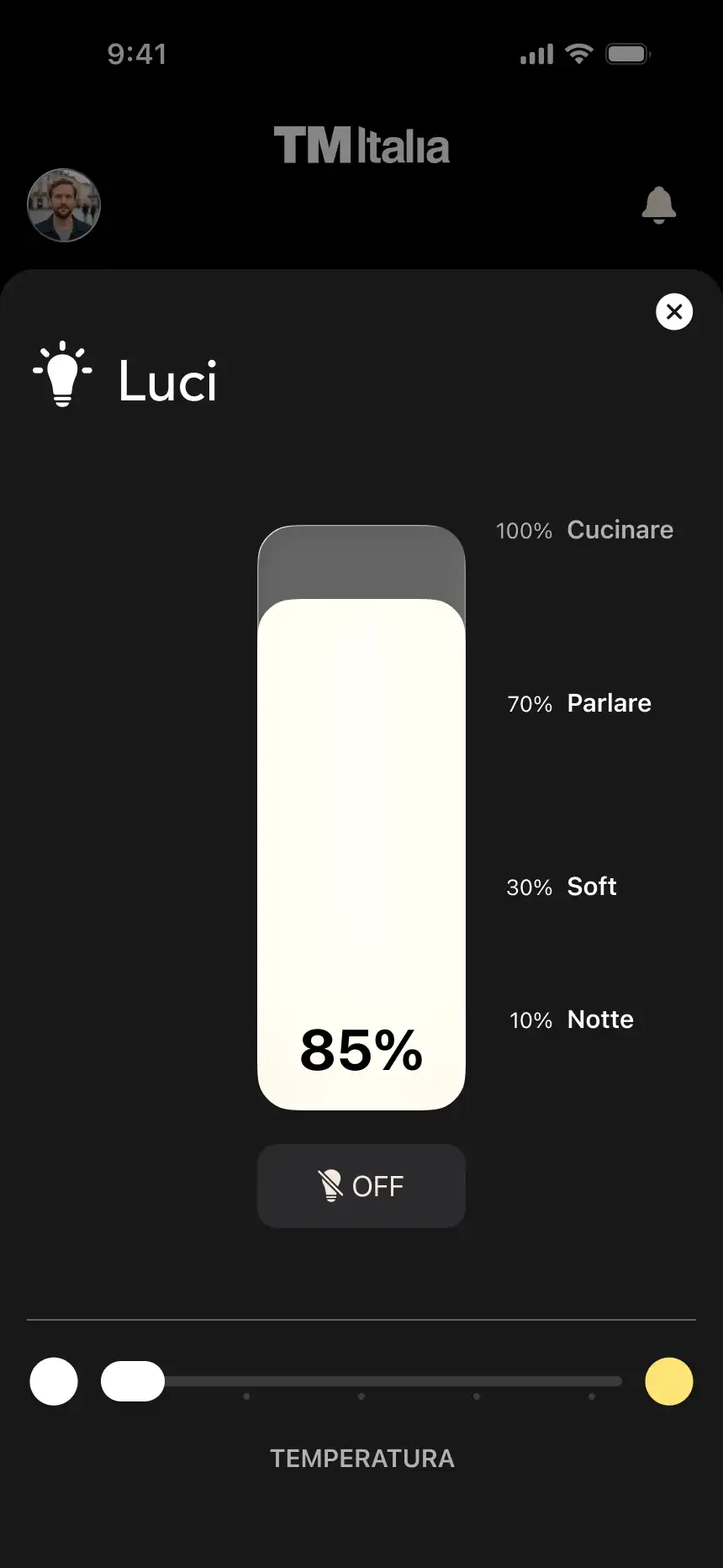
The app also integrates with Siri, Google Assistant, and Alexa, allowing voice control of any connected kitchen element.
The Manufacturer Backoffice
The mobile app is what makes the customer experience possible. The backoffice is what changes the business.
For a manufacturer like TM Italia, the backoffice represents a fundamental shift: instead of losing sight of the product after delivery, the company gains a live operational view of its entire connected fleet.
Fleet dashboard and KPIs. At a glance: how many kitchens are active, where they are, what hardware kit is installed in each, and how the fleet is performing overall. This is the kind of real-world product intelligence that has historically been unavailable to manufacturers of physical goods.
Kitchen identity. Every connected kitchen receives a digital profile: model, serial number, list of components, installed kits, installation date, and assigned installer. This is not just a registry: it is the manufacturer's CRM for physical products. When a customer calls support, the team already knows exactly what is installed and how it has been behaving.
Installer management. Installers receive dedicated credentials and work through structured, digital commissioning workflows. Every installation is tracked. The manufacturer gains quality control, performance metrics, and a systematic digital relationship with its installation network, replacing informal processes with traceable ones.
Product catalog and QR codes. Products are registered in the backoffice catalog, and QR codes for customer onboarding are generated and managed from the same interface.
Remote diagnostics. A ticketing system enables the support team to investigate reported issues remotely, with full access to device state, event history, and sensor readings for any kitchen in the fleet.
The Infrastructure: Connhex and Home Assistant
The local automation layer runs on Home Assistant, the leading open-source home automation platform. Each TM Italia kitchen uses the open-source Connhex add-on for Home Assistant that establishes secure, bidirectional communication between the local installation and Connhex Cloud.
This architecture has practical consequences. The kitchen continues to operate fully (local automations, scenario execution, device control) even without an internet connection. When connectivity is restored, the cloud and the local installation synchronise automatically.
The hardware layer uses Shelly sensors and actuators: smoke detection, gas monitoring, water leak sensing, relay control for motorised elements, and LED lighting. Shelly devices integrate natively with Home Assistant and are well-suited to kitchen environments.
On the cloud side, Connhex handles everything: provisioning (generating the digital identity of each physical kitchen before it leaves the factory), secure authentication and RBAC for installers and end customers, time-series data storage, the rules engine that evaluates sensor readings and triggers notifications, and the APIs consumed by both the app and the backoffice.
Beyond the Kitchen
TM Italia now knows which scenarios its customers actually use, how often safety alerts fire, which components generate the most support requests, and when each kitchen was commissioned and by whom. None of this was available before.
That visibility changes how a manufacturer thinks about its products. Warranty decisions can be grounded in real usage data rather than conservative estimates. After-sales touchpoints become timely rather than generic. When a component reaches end of life, the manufacturer already knows which customers are affected and can reach them directly.
The relationship with the installation network changes too. Every commissioning job is tracked. Installers work through a guided digital process rather than paper forms. Quality issues surface early, before they reach the customer.
And the end customer, for the first time, has a kitchen that is genuinely aware of itself.